Work benefits · 2027 HSA limits
Compare the cost.
Then check the cash.
Compare two health plans over a year, then explore HSA tax assumptions, bill timing, and a separate long-term balance illustration.
Calculator math runs in this browser. The calculator code does not send your entries to our server or write them to browser storage.

Fictional example loaded. These amounts are made up, not your plan. Edit any number to use your own assumptions, or choose Clear numbers to start over.
Your estimate
Compare the year
Enter the plan numbers and care estimate, then choose “Compare these plans.”
Before choosing, check that the doctors and facilities you use are in-network, how prescriptions and visits are covered, whether you could handle the bill before savings build up, and the HSA's eligibility and investment fees. The lower cost estimate alone does not decide plan fit.
Annual cost comparison
Both bars use the same zero-centered scale; values below zero remain visible as negative.
| Amount | Plan A · PPO | Plan B · HDHP/HSA |
|---|---|---|
| 12 monthly premiums | ||
| Estimated covered-care share | ||
| Employer HSA contribution (subtracted once) | ||
| Estimated tax savings on your deposits (subtracted once) | ||
| Estimated net yearly cost |
Your own HSA deposits are not treated as a medical expense. Employer HSA money and any tax estimate are shown as separate offsets; do not add those same amounts again.
Tax estimate breakdown
No tax estimate is included. Open the optional tax assumptions and enter rates if you want to explore this.
The estimate shown here is already included once in Plan B above. It is not an extra discount to add again.
| Tax category | Estimated amount |
|---|---|
| Federal income tax | |
| State income tax | |
| Payroll tax on eligible paycheck deposits | |
| Estimated total |
How the estimate is calculated
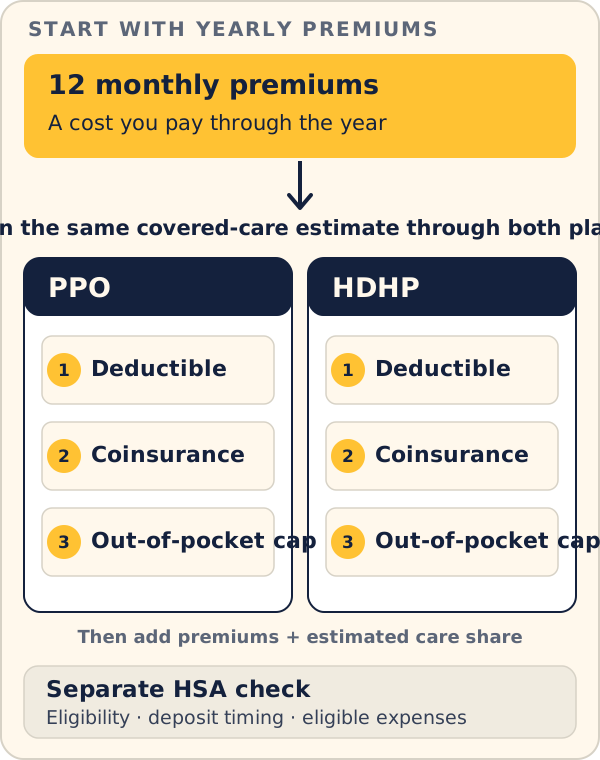
Estimated net yearly cost = 12 monthly premiums + your estimated share of entered covered care − employer HSA deposits − (only when enabled) estimated tax savings on your own HSA deposits. The cost share uses the entered deductible, coinsurance, and out-of-pocket maximum. It is a simplified estimate, not an enrollment recommendation.
The HSA projection below is separate. It does not change the yearly result, and its ending balance is not another discount to subtract from that result.
Bill timing check
HSA balance illustration · 10, 20, and 30 years
| Time | Deposited principal | Investment gain or loss after fees | Estimated account fees actually collected | Estimated ending balance |
|---|
This is a hypothetical HSA account balance, not a comparison against investing with a PPO. You may be able to save or invest with either plan. Do not add this balance to the yearly estimate or subtract it as a plan discount. Returns can be negative; future limits, eligibility, fees, and care costs can change.
This visual is a reading guide, not another input or step: it separates yearly premiums from in-network cost sharing, then shows why HSA eligibility and deposit timing need their own checks.
Paul On Money · published video
Watch the walkthrough
HDHP vs PPO: Is the Cheaper Plan Really Cheaper?
The player loads when you choose Play. Your calculator entries are not shared with the video.
If the player does not load, watch the video on YouTube .
Limits, assumptions, and sources
For 2027, federal HSA contribution limits are $4,500 for self-only coverage and $9,000 for family coverage, including employer deposits. A qualifying person age 55 or older may have a separate catch-up contribution. Check current IRS rules and your plan. The limit changes over time.
Source: IRS Revenue Procedure 2026-24, published June 15, 2026; checked October 17, 2026.
HSA contribution eligibility, qualified medical expenses, and the tax treatment of account earnings depend on IRS rules. See current IRS Publication 969; checked October 17, 2026. The investment illustration is a hypothetical calculation, not a forecast or promise.
This tool does not account for every plan rule, copay, prescription, out-of-network amount, noncovered bill, family-member deductible, investment return, account fee, tax situation, or eligibility exception. For family coverage it treats the family as one total. Check your benefits guide, IRS guidance, and payroll treatment.
Educational information only, not financial, tax, legal, or medical advice.