
PPO and HDHP describe different things
A PPO is a type of provider network. A network is the doctors, hospitals, and pharmacies that have contracts with a health plan. PPOs usually cost less when you use in-network providers. They may also cover out-of-network care, but you can pay more for it. A high-deductible health plan (HDHP) is a plan that meets federal rules for deductibles and yearly limits. A health savings account (HSA) is a separate account for certain medical costs. You can put money into an HSA only if you meet separate IRS rules. These labels describe different things: PPO describes network access; HDHP describes plan rules; HSA describes an account. A PPO can be an HDHP, but neither label tells you every cost or whether you can contribute to an HSA. [3] [4] [8]
For months beginning after December 31, 2025, some individual-market plans sold through an ACA Exchange and labeled Bronze or Catastrophic are treated as HDHPs for HSA purposes. This special rule does not cover every plan with those labels. You still must meet the other IRS rules before you can contribute to an HSA. [10] [6]
Compare the exact plans your employer offers. Your specialist may be out of network, a prescription may have different rules, or a large first bill may be hard to pay. HealthCare.gov says to compare the premium with the deductible and other costs you may pay. The plan with the lowest premium is not always the cheapest for the year. [1] [3]
Compare the yearly cost—and when bills arrive
Start with the premium: your share of the insurance price. You pay it even in a year when you do not get care. Multiply the monthly amount by 12. Then add your share of covered care. For many services, the deductible is the amount you pay before the plan starts sharing costs; your plan may cover some care sooner. A copay is a set dollar amount for a service. Coinsurance is the percentage you pay for certain services after the deductible. The in-network out-of-pocket maximum is a cap on what you pay in a plan year for covered in-network care. It usually does not include premiums, out-of-network care, or services the plan does not cover. Check your plan because rules can differ by service. [1] [6] [9]
Annual premiums + your share of covered care − employer HSA deposit − optional estimate of tax savings on your own eligible HSA deposits
Do not count your own HSA deposit as a medical cost; the money stays yours until you spend it. The calculator’s optional tax estimate applies the federal and state rates you enter to your own eligible deposits; it applies a payroll-tax rate only to eligible paycheck deposits. Keep payroll and direct deposits separate. If your take-home-pay or tax estimate already reflects a benefit, do not subtract that same benefit again. The calculator does not guess your tax rate or state rules. Employer deposits count toward the yearly HSA limit. Count the deposit once as account money, not again as your personal tax saving. [6] [9]
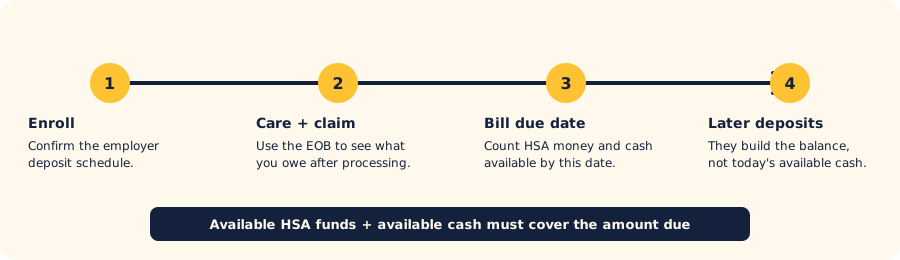
Check bill timing in four steps
- At enrollment, find out when your employer will deposit money into the HSA.
- After care, check your insurer’s explanation of benefits (EOB) to see your share after the claim is processed.
- By the bill’s due date, compare the amount due with HSA money and other cash you can use by then.
- Count later deposits only when they arrive. They add to the balance later; they cannot pay a bill already due.
A made-up 2027 example, worked step by step
This worked example uses the calculator’s “Me and my spouse” tier. Enter the plan terms below by hand to repeat the totals; the “Try a fictional example” button loads different numbers. The terms here are made up, not a quote from an employer. We assume HSA eligibility, $500 from the employer, covered in-network care, no personal HSA deposits, and no tax-savings estimate. The calculator combines family care into one total and does not model each person’s deductible. Real family plans may have separate person-level rules, so check the Summary of Benefits and Coverage. [9] [1]
| Plan | Monthly premium | Deductible | Coinsurance after deductible | In-network out-of-pocket limit | Employer HSA deposit |
|---|---|---|---|---|---|
| PPO example | $199 | $1,400 | 15% | $7,000 | $0 |
| HDHP/HSA example | $49 | $3,800 | 20% | $7,600 | $500 |
Compare $3,000 of allowed in-network care as a lower-use year, $15,000 as a middle-use example, and $40,000 as a high-cost test. The allowed amount is the price the plan uses for a covered service before you and the insurer split the cost. It can be lower than the provider’s listed price. These amounts are examples, not predictions. [9] [1]
This simple model uses one deductible, one coinsurance rate, and one in-network out-of-pocket limit for covered care. It leaves out separate visit or prescription copays, special rules for some services, out-of-network care, and bills the plan does not cover. It also does not model a separate deductible for each family member. Check the exact Summary of Benefits and Coverage and plan documents. The calculator helps compare numbers; it cannot replace the plan documents. [9] [2] [5]
$3,000 allowed in-network care
- PPO
- $4,028
- HDHP/HSA
- $3,088
$9,000 allowed in-network care
- PPO
- $4,928
- HDHP/HSA
- $4,928
$15,000 allowed in-network care
- PPO
- $5,828
- HDHP/HSA
- $6,128
$27,400 allowed in-network care
- PPO
- $7,688
- HDHP/HSA
- $7,688
$40,000 allowed in-network care
- PPO
- $9,388
- HDHP/HSA
- $7,688
| Allowed in-network care | PPO yearly total | HDHP/HSA yearly total | Lower total in this example |
|---|---|---|---|
| $3,000 | $4,028 | $3,088 | HDHP/HSA by $940 |
| $9,000 | $4,928 | $4,928 | Tie |
| $15,000 | $5,828 | $6,128 | PPO by $300 |
| $27,400 | $7,688 | $7,688 | Tie |
| $40,000 | $9,388 | $7,688 | HDHP/HSA by $1,700 |
| Care amount and plan | 12 months of premiums | Your share for care | Employer HSA money | Yearly total |
|---|---|---|---|---|
| $3,000 care · PPO | $2,388 | $1,640 | $0 | $4,028 |
| $3,000 care · HDHP/HSA | $588 | $3,000 | $500 | $3,088 |
| $15,000 care · PPO | $2,388 | $3,440 | $0 | $5,828 |
| $15,000 care · HDHP/HSA | $588 | $6,040 | $500 | $6,128 |
| $40,000 care · PPO | $2,388 | $7,000 | $0 | $9,388 |
| $40,000 care · HDHP/HSA | $588 | $7,600 | $500 | $7,688 |
With these plan numbers, the totals tie at $9,000 and $27,400 of allowed care. Those are the break-even points: the totals are equal there. Between them, the PPO costs less in this model; at $15,000 of care, it is $300 lower. Actual copays, covered services, provider rates, family deductibles, and when employer money arrives can change these points—or remove them. [9] [2] [3]
At $3,000 of allowed care, you pay the PPO deductible of $1,400, then 15% of the remaining $1,600. That 15% is $240, so your care share is $1,640. Add $2,388 in yearly premiums: the PPO total is $4,028. The HDHP deductible is $3,800, so you pay the full $3,000 of care in this example. Add $588 in premiums and subtract the employer’s $500 HSA deposit once: the total is $3,088. The HDHP/HSA total is $940 lower. [9]
At $40,000 of allowed care, both plans reach their in-network out-of-pocket limit. The PPO total is $7,000 in care costs plus $2,388 in premiums, or $9,388. The HDHP/HSA total is $7,600 in care costs plus $588 in premiums, minus the employer’s $500 deposit, or $7,688. In this high-cost test, the HDHP/HSA is $1,700 lower. These results come from these made-up premiums, cost rules, limits, and employer deposit. An HDHP will not always cost less. [9] [5]
A lower yearly total can still leave an early cash gap
The yearly table does not show when money arrives. In a separate made-up timing check, a $2,000 qualified medical bill is due, $1,000 is already in the HSA, and no other cash is set aside. The HSA can pay $1,000, leaving a $1,000 gap by the due date. This example is about timing. Do not add it to the medical costs in the yearly examples. [9] [6]
Before choosing an HDHP, check when the employer deposit arrives and when your payroll deposits start. Ask how much HSA money will be ready before your first large bill. An explanation of benefits (EOB) is the insurer’s statement showing how it processed a claim and what you may owe. A goal for how much to save this year is not the same as money already in the account. Do not count a future deposit toward a bill due today. [9]
- Find the employer’s HSA deposit schedule in the benefits guide or HSA enrollment materials.
- Use the insurer’s explanation of benefits (EOB) to see how it calculated your share after a claim.
- Keep enough easy-to-reach savings for the bills you may need to pay before HSA money arrives.
When a PPO can be the better fit
A PPO may fit better if its network includes the doctors and facilities you want, if its out-of-network rules matter to you, or if its visit and prescription costs fit your needs. Check the exact provider list and plan rules; the PPO label alone does not guarantee them. In the made-up example, the PPO is also $300 lower at $15,000 of covered in-network care. A higher premium pays for that plan’s network and cost-sharing rules. Whether that is worth it depends on your care and budget. [3] [1] [5]
The PPO may also be easier to budget if the HDHP’s early deductible would strain your cash savings, even when the HDHP has a lower yearly total in the example. The amount you might pay over the year and the cash you need by an early due date are different questions. Decide which trade-off matters more for you.
Check HSA eligibility, limits, and withdrawal rules
Having an HDHP does not automatically let you put money in an HSA. IRS rules also check your other health coverage, whether someone can claim you as a dependent, whether you are enrolled in Medicare, and which months you qualify. A spouse’s general-purpose health flexible spending account (FSA), an employer account for medical costs, may also affect your eligibility. Check your situation with your benefits team and current IRS guidance before treating a deposit as tax-advantaged. [6]
For 2027, the IRS has a limited rule for certain direct-primary-care arrangements. These are arrangements for access to primary care. The fee and other conditions matter, so check the 2027 IRS guidance if you use one. [8]
| Calendar year | Base HSA limit before catch-up · self-only | Base HSA limit before catch-up · family | Minimum deductible · self-only | Minimum deductible · family | Max covered out-of-pocket · self-only | Max covered out-of-pocket · family |
|---|---|---|---|---|---|---|
| 2026 | $4,400 | $8,750 | $1,700 | $3,400 | $8,500 | $17,000 |
| 2027 | $4,500 | $9,000 | $1,750 | $3,500 | $8,700 | $17,400 |
The HSA contribution limit is per calendar year, even if your medical plan year starts on another date. If both spouses are individually eligible to contribute and either spouse has family HDHP coverage, they share one combined family limit; it is not a full family limit for each spouse. They can decide how to split it. Employer contributions count toward the shared limit. An eligible person age 55 or older at the end of the tax year may contribute an additional $1,000 to their own HSA. If both spouses qualify for a catch-up, each needs their own account. Partial-year rules can change the limit, so check current IRS instructions before you contribute. The HDHP deductible and out-of-pocket thresholds do not set the exact amounts in every employer plan. [6] [7] [8]
An HSA can have tax benefits when money goes in, while it stays in the account, and when you spend it on qualified care. Your own contributions may be deductible. Employer contributions are generally not counted as income. HSA earnings generally are not taxed while they stay in the account. Money used for qualified medical expenses is generally not taxed when you take it out. The result can depend on how the money was deposited and on state rules. Do not claim employer money as your own deduction or count it twice. Leave the calculator’s tax estimate off unless you can support the numbers you enter. [6] [9]
HSA money generally stays in your account from year to year. To take it out tax-free, the money must pay an IRS-qualified medical expense that happened after the HSA was established (opened). The expense must not already have been paid or reimbursed by insurance or another source, and you cannot claim the same expense as an itemized medical deduction. Keep the receipts. A withdrawal for another purpose is generally taxable and may face an extra tax before age 65, with some exceptions. At age 65 or older, the extra tax generally no longer applies, but regular income tax may still apply. Some HSA providers let you invest the balance. Investments can lose value, and fees can reduce returns. Keep money for near-term bills easy to reach. Growth is not guaranteed. [6]
Could an HSA balance grow over time?
Some HSA providers let you invest money left in the account after bills are paid. Investment earnings may add to the balance, and later earnings can grow on earlier earnings. This is called compounding. Investments can also lose value. Keep enough money easy to reach for near-term bills before investing. Each provider sets its own fees and rules. [6] [9]
A simple projection, not a promise
This separate example starts with $0. The account holder adds $1,000 at the end of each year. It assumes the investment earns 5% each year before a 0.05% fund fee. It assumes no separate HSA account fee, employer deposits, withdrawals, inflation adjustment, or tax savings. Each deposit must be allowed and fit within that year’s remaining HSA limit. The amounts are nominal dollars, which means they are not adjusted for inflation, and they are rounded to the nearest dollar. Real investments do not earn the same return every year and can lose money. [9] [6] [7] [8]
10 years
- Deposited
- $10,000
- Modeled gain
- $2,549
- Ending balance
- $12,549
20 years
- Deposited
- $20,000
- Modeled gain
- $12,892
- Ending balance
- $32,892
30 years
- Deposited
- $30,000
- Modeled gain
- $35,871
- Ending balance
- $65,871
| Years | Total deposited | Modeled gain after fund fee | Ending balance |
|---|---|---|---|
| 10 | $10,000 | $2,549 | $12,549 |
| 20 | $20,000 | $12,892 | $32,892 |
| 30 | $30,000 | $35,871 | $65,871 |
The ending amount changes when the return assumption changes. With the same deposits and fund fee, a steady −2% gross return leaves about $22,576 after 30 years; a 0% return leaves $29,784; and a 5% return leaves $65,871. These are calculator examples, not forecasts. Real returns rise and fall rather than staying at one rate. At 0%, the fund fee makes the ending amount slightly lower than the $30,000 deposited. [9]
| Assumed yearly return before fund fee | Ending balance |
|---|---|
| −2% | $22,576 |
| 0% | $29,784 |
| 5% | $65,871 |
The IRS generally does not tax HSA earnings while they stay in the account. To take money out tax-free, it still must pay a qualified medical expense. Keep the receipts and records. Delaying a payment from the HSA may leave more money invested, but only consider that if you can comfortably pay the bill another way and keep the records. It is also okay to use the HSA for a qualified bill now. A PPO does not stop you from investing in other accounts; HSA rules are a separate question. [6]
Where to find each number
- Your premium: find your share in the open-enrollment rate sheet, benefits website, or paycheck page. Use what you pay, not the full price of the plan. If you pay every paycheck, add the year’s payments and divide by 12.
- Deductible, coinsurance, copays, and out-of-pocket maximum: check the Summary of Benefits and Coverage (SBC), plan certificate, or summary plan description. Look for in-network and self-only or family rules, including separate person-level deductibles.
- Doctors, hospitals, and medicines: check the insurer’s current provider list and drug list for the exact plan name. A drug list is also called a formulary.
- Expected care: use the insurer’s price estimator or a past explanation of benefits (EOB). The allowed amount is the plan’s price for a covered service, not always the provider’s listed price.
- Employer HSA money and timing: check the written benefits guide, HSA materials, payroll election, and deposit dates. Keep employer deposits separate from your own money.
- HSA eligibility and limits: check the current IRS Publication 969 and the IRS notice for the calendar year you will contribute. Check again when your coverage or Medicare status changes.
A practical comparison checklist
- Write down when coverage starts and whether your plan year matches the calendar year used for HSA limits.
- Confirm what you pay for the premium and whether your doctors, hospitals, and prescriptions are in the plan’s network.
- Copy the deductible, copays, coinsurance, and in-network and out-of-network limits from the exact plan documents.
- Compare lower, middle, and high amounts of covered in-network care. Do not include uncovered or out-of-network bills in an in-network maximum.
- Enter only employer HSA money you know you will receive. Count it once. Your own HSA deposits remain your money.
- Check whether you can contribute to an HSA, the current yearly limit, and whether other coverage changes your eligibility.
- Ask when HSA deposits arrive. Check whether HSA money already available, plus your own cash buffer, can cover an early bill.
- Compare the yearly totals with the bill timing. Choose the trade-off that fits your providers, budget, and comfort with risk.
Evidence checked 2026-10-17
Sources and notes
- 1HealthCare.gov: Your total costs for health careChecked 2026-10-17
- 2
- 3HealthCare.gov: Preferred Provider Organization (PPO)Checked 2026-10-17
- 4HealthCare.gov: High Deductible Health Plan (HDHP)Checked 2026-10-17
- 5HealthCare.gov: Out-of-pocket maximum/limitChecked 2026-10-17
- 6
- 7IRS Revenue Procedure 2025-19: 2026 HSA limitsChecked 2026-10-17
- 8IRS Revenue Procedure 2026-24: 2027 HSA limitsChecked 2026-10-17
- 9
- 10
- 11
Tax thresholds are year-specific. Recheck IRS guidance for the calendar year you contribute and your own plan documents before enrolling.